
Christmas For Jimmy Lee Bailey: A Child in Need of Love

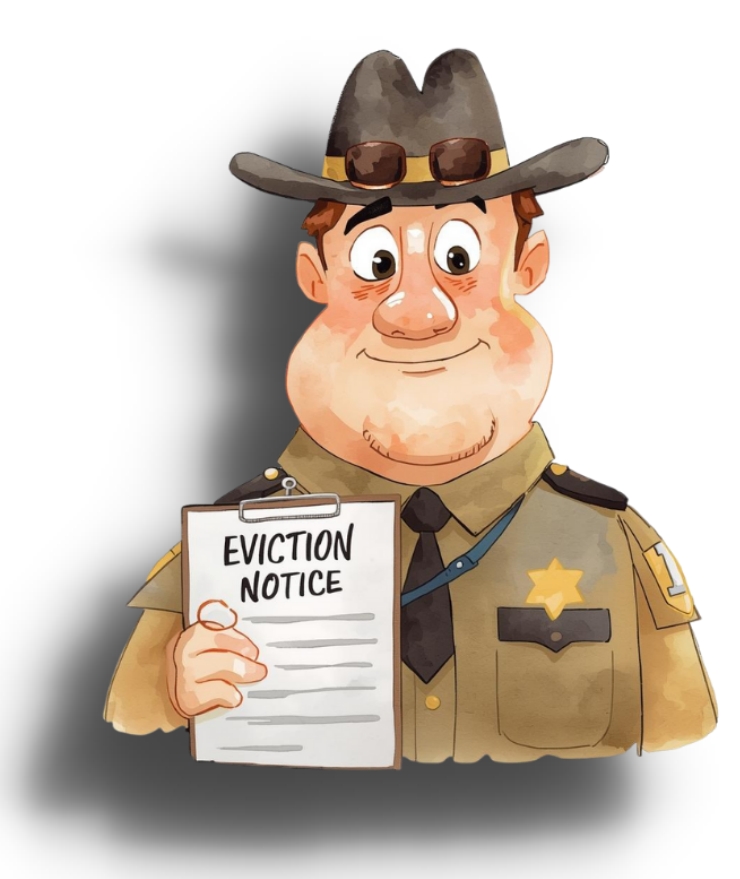
The call—a child in need of services.

What I found was a child in need of love.

His tired old house squatted at the end of a hard-packed red clay path like something that had crawled there to die. The long driveway was nothing more than two well-worn ruts separated by a strip of dead weeds. It was flanked by Johnson grass gone to seed, old tires, scraps of paper and soggy boxes that had once held microwave dinners, and a few plastic Piggly Wiggly bags snagged on blackberry thorns.

The structure, itself a notch below “shack status,” reeked of poverty, evidenced by mismatched clapboards covering the frame in a patchwork that spoke of salvage yards and debris piles. Each board a different shade of gray or brown, tar paper curling back from the edges like burnt skin, and the roof covered with tin sheets the color of dried blood hammered down with roofing nails that had already begun their slow rust-journey back to the earth. Underneath it all, plywood gone black from years of rain pouring through vacant nail holes and splits in the metal and termite infested cladding.

The walls leaned in ways that defied geometry, each corner refusing to meet at ninety degrees. No concrete footings and that it was obvious that the place had not seen the use of a framing square or a carpenter’s level were clear signs that no building inspector had ever set eyes on the place. The whole thing canted slightly to the east like it was trying to gently ease its tired frame to its knees for a long overdue rest.

Various bits of litter dotted the dirt yard—old and weather-damaged lottery tickets, sun-faded condom wrappers and empty fast-food containers, and numerous bits of aluminum foil and thumb-size zip lock bags, packaging used to contain crack cocaine and other drugs. A waist-high pile of empty beer cans and liquor bottles was the centerpiece of the backyard. Near the woods at the rear of the property, the collapsed remains of what used to be a doghouse lay in a shallow, ice-crusted puddle of brown water.

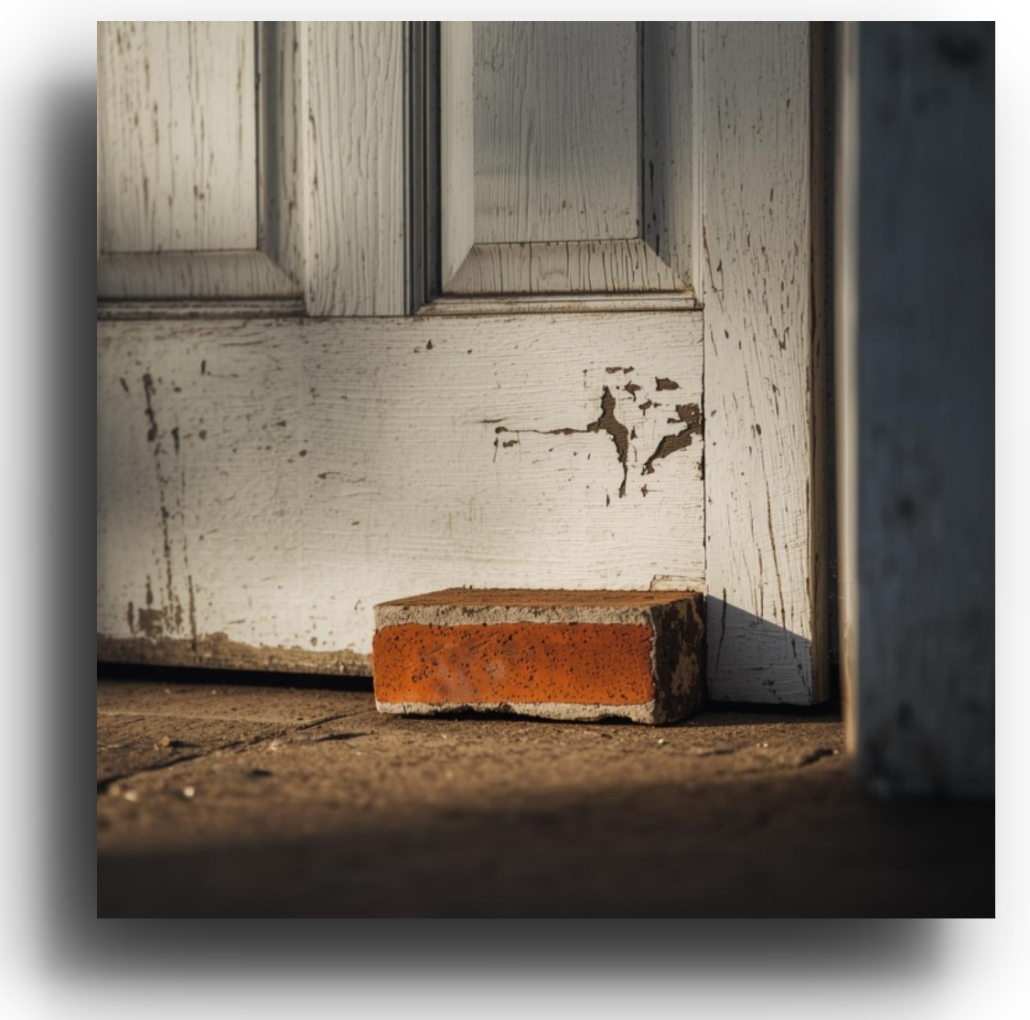
Four white cinder blocks, spray-painted like someone had tried to give the place dignity, served as a front stoop. The front door had no knob or lock, just a curved metal handle worn slick from years of pulling and pushing. A brick propped against the bottom held it closed. Someone, I’m not sure who, “locked it” when they left.


I knocked.

“Come in,” a little voice said.

I used the toe of my boot to push the brick to one side.

It was just days before Christmas.

There was no tree.

No presents.

No food.

No running water.

No cabinets. No stove.

No refrigerator. No beds.

No drywall. No insulation.

Just bare studs and crooked rafters.

And cold.

Lots of cold.

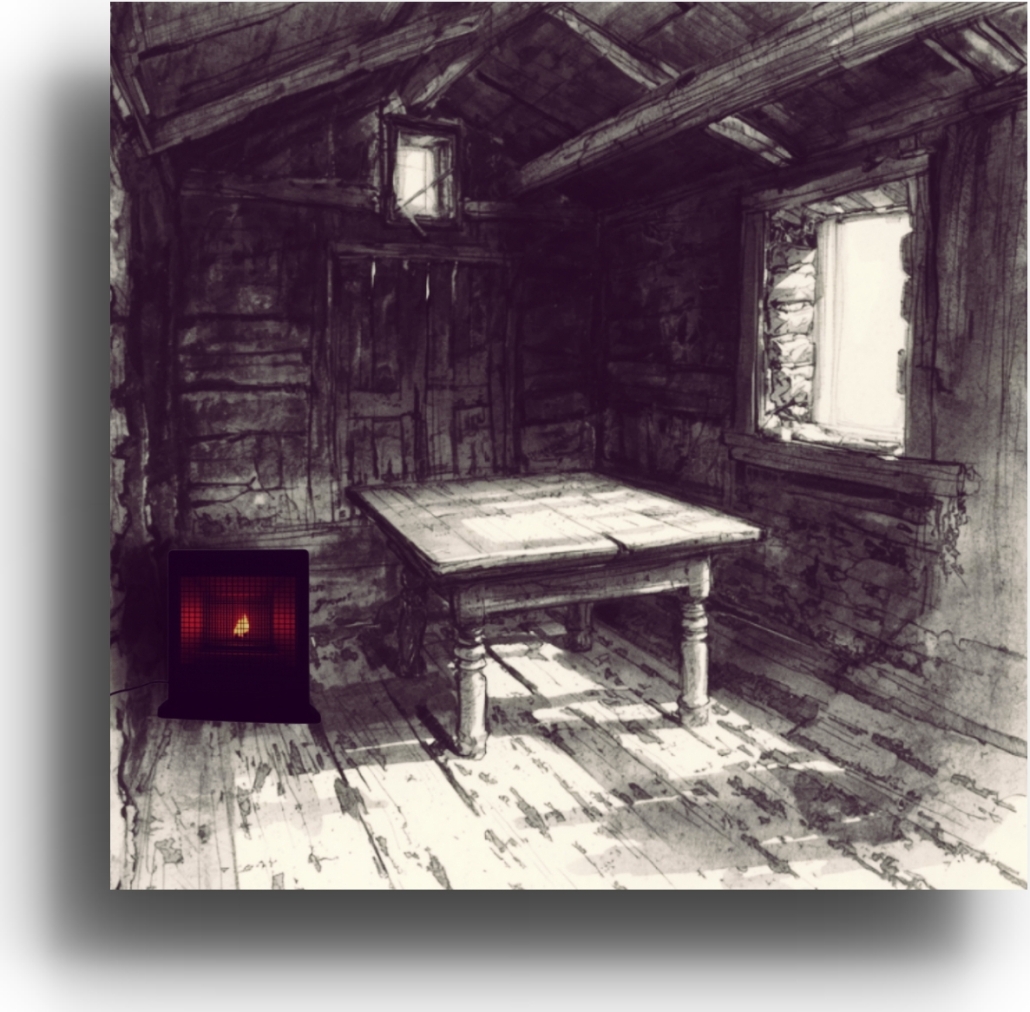
A small dented and soot-caked kerosene heater fought a losing battle against a brutal December evening. Two re-purposed milk jugs used for holding fuel sat near the splintered front door. Both empty. The heater’s gauge rested at one click above E. The weak orange flame destined to fade away.


The temperature outside was 20, and dropping. The wind persistently forced its way through cracks and holes in the walls, floor, and gaps around the door and windows.

The place was not much more than a garden shed cobbled together from scrap wood and discarded “whatevers.”

A tattered blanket and two patchwork quilts. Threadbare and slick from wear.

No winter coats. No hats, nor gloves.

Dirty window panes.

One missing, a square of cardboard in its place.

Dish towel curtains.

A hardware store calendar, two years old, hung on a dingy wall.

A cooler with no lid.

Mom, passed out on the floor.

A whiskey bottle, its contents long gone.

A pipe for crack smoking.

“Mama says daddy will come home … someday.”

A dog. Three stubby legs, All ribs and backbone.

Sad eyes and broken spirit.

The floor, bare.

No rugs, no toys. ­

A table.

Two chairs.

A book.

Three sheets of paper.

The boy, writing.

Cigarettes.

A saucer for ashes, overflowing with discarded butts.

A deck of ragged playing cards.

Roaches. Scurrying up, down, there and here.

Mouse. Unafraid.

A squalling baby. Covered with a yellowed hotel bath towel.

The bugs, they’re there, too.

The stench.

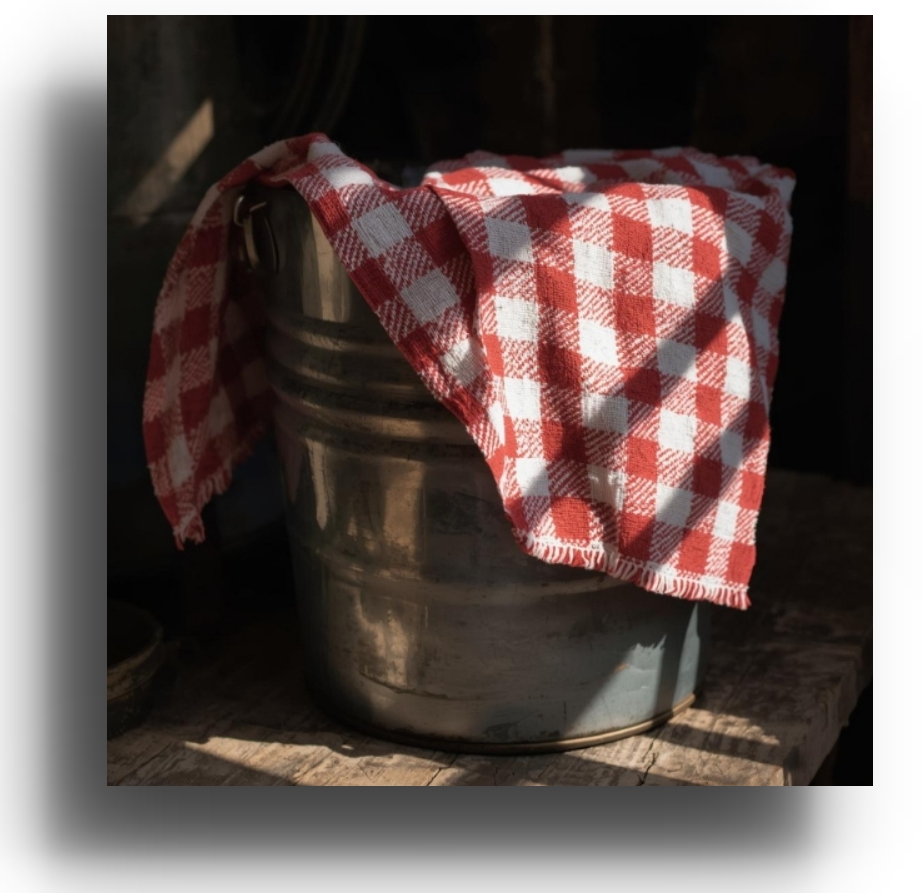
A tin lard bucket in the corner.

A checkered cloth on top.

A half-empty roll of Scotts.

The only bathroom indoors.

“You writing a letter?”

A nod.

“To your Dad?”

“No, to Santa.”

“Mind if I have look?”

He held it up for me to see.

“Your handwriting is very nice.”

A smile.

“Dear Santa,

Don’t worry about the bicycle I asked for.

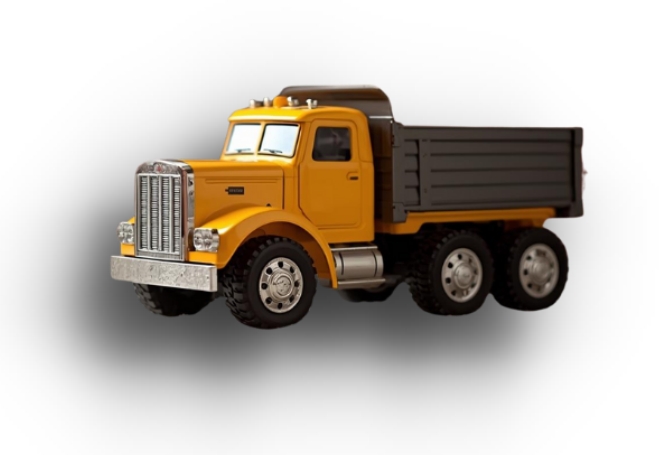
Or the Tonka trucks and new coat.

And I don’t even like video games anymore.

Or videos and toy trains.

I’m too big for those things now.

‘Sides, some men came and took the TV. Said Mama couldn’t pay for it no more. The ‘lectric neither.

What I’d really like is a warm blanket for my brother. He needs some milk too. And some medicine to make his fever go away. And could you help my Mom some? She needs to stop drinking and smoking. I wish you could make those men leave her alone too. They get all lickered up and hit her and do things to her that make her cry. Maybe you could bring my mom a coat for Christmas this year. She don’t have one and she gets cold when she walks down the street to get her cigarettes and that other stuff she smokes.

And if you don’t mind too much could you bring my daddy something to eat. He don’t never have no money. And if you see God while you’re up there flying around please tell him to say hi to my baby sister. And ask him to tell her I’m sorry I couldn’t make Mama wake up and take her to the hospital. If you can do all that, don’t worry about bringing me nothing. I’d like that just fine.”

Your friend,

Jimmy Lee Bailey

*Jimmy Lee Bailey was definitely in need of love. So, after medical care for his mom and when Christmas morning rolled around, he got his truck, a bicycle, and a new coat. He also enjoyed a nice meal before moving to his new home. All courtesy of his new friends, the officers who patrolled the graveyard shift.


The Twelve Nights Of Christmas Graveyard Shifts

The Twelve Nights Of Graveyard Shift

On the first night of graveyard my sergeant gave to me, a car-tri-idge and a cuff key.

On the second night of graveyard my sergeant gave to me, two prostitutes, and a car-tri-idge and a cuff key.

On the third night of graveyard my sergeant gave to me, three stinky winos, two prostitutes, and a car-tri-idge and a cuff key.

On the fourth night of graveyard my sergeant gave to me, four calls from wackos, three stinky winos, two prostitutes, and a car-tri-idge and a cuff key.

On the fifth night of graveyard my sergeant gave to me,  five ….. cans ….. of ….. pepper-spray, four calls from wackos, three stinky winos, two prostitutes, and a car-tri-idge and a cuff key.

On the sixth night of graveyard my sergeant gave to me, six drunks a-peeing,  five … cans … of … pepper-spray, four calls from wackos, three stinky winos, two prostitutes, and a car-tridge and a cuff key.

On the seventh night of graveyard my sergeant gave to me, seven robbers running, six drunks a-peeing, five … cans … of … pepper-spray, four calls from wackos, three stinky winos, two prostitutes, and a car-tri-idge and a cuff key.

On the eighth night of graveyard my sergeant gave to me, eight maids embezzling, seven robbers running, six drunks a-peeing, five … cans … of … pepper-spray, four calls from wackos, three stinky winos, two prostitutes, and a car-tri-idge and a cuff key.

On the ninth night of graveyard my sergeant gave to me, nine ladies fighting, eight maids embezzling, seven robbers running, six drunks a peeing, five … cans … of … pepper-spray, four calls from wackos, three stinky winos, two prostitutes, and a car-tri-idge and a cuff key.

On the tenth night of graveyard my sergeant gave to me, ten perverts peeping, nine ladies fighting, eight maids embezzling, seven robbers running, six drunks a-peeing, five … cans … of … pepper-spray, four calls from wackos, three stinky winos, two prostitutes, and a car-tri-idge and a cuff key.

On the eleventh night of graveyard my sergeant gave to me, eleven crackheads smoking, ten perverts peeping, nine ladies fighting, eight maids embezzling, seven robbers running, six drunks a-peeing, five … cans … of … pepper-spray, four calls from wackos, three stinky winos, two prostitutes, and a car-tri-idge and a cuff key.

On the twelfth night of graveyard my sergeant gave to me, twelve hours of overtime, eleven crackheads smoking, ten perverts peeping, nine ladies fighting, eight maids embezzling, seven robbers running, six drunks a-peeing, five … cans … of … pepper-spray, four calls from wackos, three stinky winos, two prostitutes, and a car-tri-idge … and … a … cuff … keeey.

A Cop’s Thanksgiving: Save a Drumstick for Me

Morning parade.

Smiling faces.

Children playing.

Marching bands.


Turkey.

Pumpkin pie.

Eggnog.

Football.


Pistol. Badge. Vest.

Kiss the kids, please.

And save a drumstick for me.

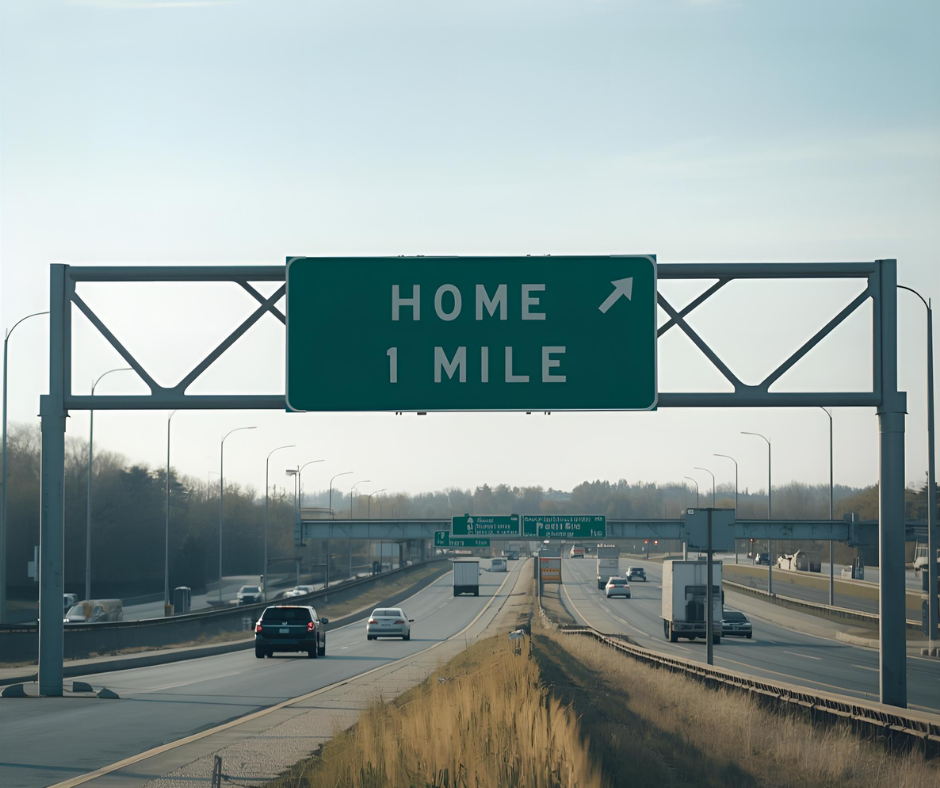
I’m almost home.


Family.

Traveling.

Traffic.

Bumper-to-bumper.

Smiling faces.

Squealing children.

Grandma’s cooking.

Turkey.


Yams.

Pumpkin pie.

Crackling fire.

Football.


Kevlar. Radios. Sirens.

Kiss the kids, please.

And save a drumstick for me.

I’m almost home.

Drunk drivers.

Speeding drivers.

Texting drivers.

Careless drivers.


Aggressive drivers.

Sleepy drivers.

Depressed drivers.

Distracted drivers.


Reckless drivers.

Road rage.

Horrible crash.

An entire family …


Gone.

Tangled metal.

Little ones.

Mother and father.

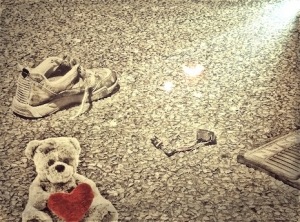
A teddy bear.


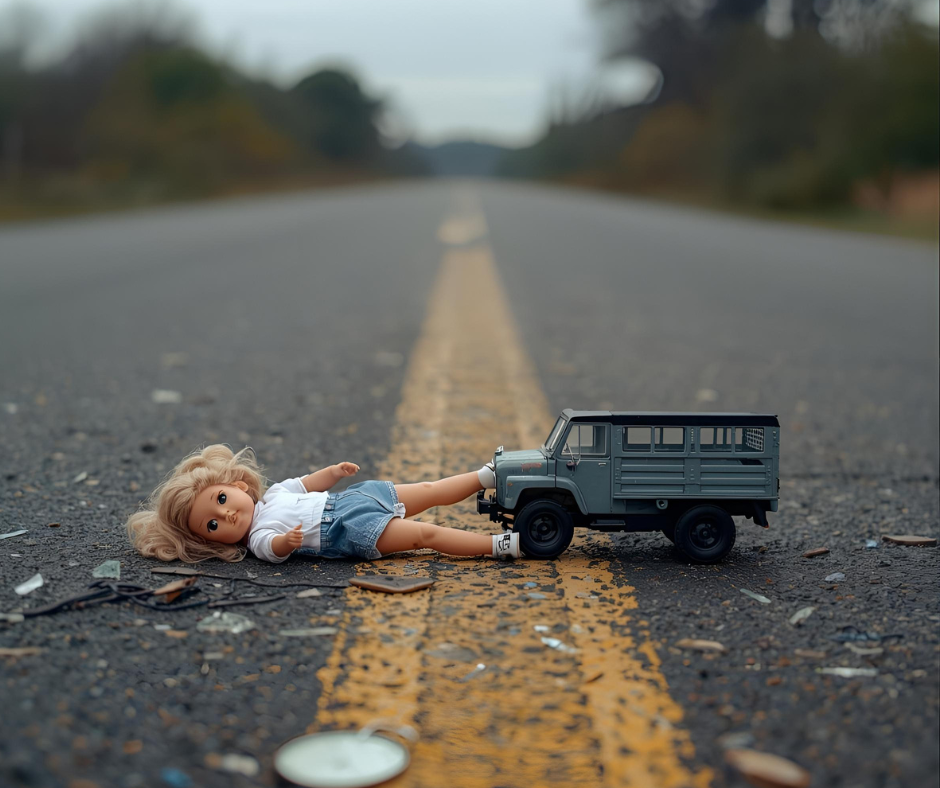
A doll and a toy truck.

Those poor children.

They’ll never go home again.

Yes, save a drumstick.


Hug our kids.

Tell them I love them.

I’ll be home,

Later.


10-4.

Send the coroner.

Five victims.

No rush.


I’ll stand by.

Nothing I can do.

Those poor children.

No turkey.


No pumpkin pie.

No football.

Never again.

They were almost home.

Almost home …


Dead Women Sometimes Cry in the Rain, And Baby Socks

If I’ve heard it once, I’ve heard it a thousand times—Never start a story with the weather.

Even Elmore Leonard kicked off his “Don’t-do-it” list with a rule about using atmospheric conditions to open a story.

  1. Never open a book with the weather.
  2. Avoid prologues.
  3. Never use a verb other than “said” to carry dialogue.
  4. Never use an adverb to modify the verb “said.”
  5. Keep your exclamation points under control!
  6. Never use the words “suddenly” or “all hell broke loose.”
  7. Use regional dialect, patois, sparingly.
  8. Avoid detailed descriptions of characters.
  9. Same for places and things.
  10. Leave out the parts readers tend to skip.

Now, with that said and with an absolute clear understanding of the rules—NO Weather!—let’s get on with the show, today’s true story. It’s a real-life account that’s mixed with a bit of excitement and emotional ups and downs. It’s also a rule breaker that begins, of course, with the weather.

In this instance, though, the climate plays a significant role as a character just like the humans in the story. Oh, and for good measure, I’ve also tossed in the phrase that is a definite no-go for starting a tale. I think you’ll recognize it. So here goes.

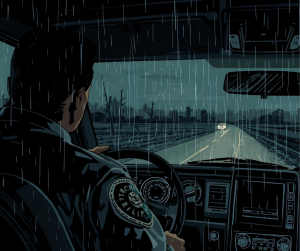
It was a dark and stormy night in our county. Rain lashed against my windshield in sheets driven horizontally by huffs and puffs of wind that played a violent to-and-fro game of tug of war with the red oaks, sweet gums, and loblolly pines flanking the country road. A large patch of overgrown kudzu engulfing an old tobacco barn and surrounding vegetation wriggled and shimmied like the flock of hoochie-coochie dancers that traveled with the carnival that passed through the area every couple of years.

It was a sideways kind of rain that TV weather reporters often battle during live coverage of the massive, roiling, churning hurricanes, storms with names like Esmerelda, Horatio, or Clyde. Their on-camera backdrops are airborne lawn chairs and garbage cans, toppling trees, and waves crashing onto houses, far from where a shoreline once existed, mere hours before the broadcasts.

Yes, it was that kind of storm, and I was out in the thick of it, patrolling county roads and checking on businesses and homes, watching for looters, and suspicious oddities, such as broken windows and open doors, and frightened farm animals who’d escaped custody. Additionally, I was on the lookout for storm-related troubles, such as downed power and telephone lines, toppled trees blocking roadways, flooding, and the unfortunate folks who’d been traveling far too fast for the conditions, landing themselves in a ditch mired to the axles and undercarriage in roadside muck.

A few hours into my shift, I’d ventured into a section of the county where houses were a couple of miles apart, and where our car radio transmission capability was spotty at best, meaning an unheard call for help could result in a hospital stay, or your body lying on a slab in the morgue with an ID tag tied neatly to your big toe. It was so deep in the middle of nowhere that even on clear nights, the moon had difficulty finding the place. The spooky factor in that area was a ten on the weird scale, and on this night, my gut was telling me that something bad was going to happen or had already happened.

Just after passing what appeared to be a dirt path to my right, I rounded a sharp leftward curve, and my headlights reflected off something metallic and shiny deep into the woods. It seemed out of place, so I decided to investigate.
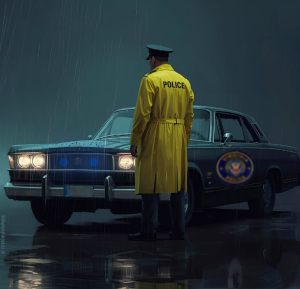
I backed up to the narrow “path” and turned into what was nothing more than two sloppy-wet parallel ruts carved by automobile tires, likely the tires of a farmer’s vehicle or utility company trucks.

As I inched forward in the slurry, thorny brush scraped along the sides of my car, sounding like fingernails on a chalkboard. Tree branches thumped the rooftop lightbar. Others slapped against the windshield like long, gnarled skeletal fingers giving the glass a series of high-fives.

Just a few yards down the trail, my rear tires began to spin and slip, so I gave the accelerator a shove. The extra power sent globs of goo spewing rearward.

The trek was touch-and-go for a while, with the front end of the car sliding from one side of the path to the other, forcing me to whirl the steering wheel in opposite directions to maintain some sort of straight line of travel. I knew I couldn’t let off the gas, or there I’d sit.

A moment or two later, though, I was through the sloshy goop and on the way toward the source of the reflection, which I soon discovered was a car parked approximately twenty yards off the dirt road in a clear-cut section along a power line, next to a river. I stopped several feet from the vehicle, enough to allow a retreat in case of an ambush. I used my spotlight to examine the car and to sweep the powerful beam across the surrounding area. I also turned on my side alley lights and the bright takedown lights on the front of the lightbar.

The place was nearly as well-lit as a high school football field on Friday night.

There was no sign of anything or anyone, but you never know what danger lies beyond the light’s reach. Again, it was dark and stormy, making it one of those scenarios where the hairs on the back of your neck and arms immediately leap to attention. But I had to forget the woods for the time being and focus on the immediate danger—the car.

I rotated the spotlight and aimed the beam back to the vehicle until I’d zeroed in on the driver’s side. To add to the skin-crawling, heart-pounding, horror movie ambiance, the door was open. However, from my angle, I could see only the outside of the door, leaving the other side and the car’s interior a mystery.

So, despite the downpour, thunder, lightning, and those hyper-vigilant hairs (the cop’s sixth sense was in complete overdrive), I had to get out to investigate. So, I did. Before taking the first step, though, I again scanned the area carefully, this time using my Maglite, the old metal kind, making sure a killer wasn’t waiting in the brush to ambush me to make their escape.

After being as certain as possible that the area was clear, I cautiously moved forward. At the same time, the winds drilled raindrops into my face and against my lemon-yellow vinyl raincoat, the one I usually kept in the trunk of my patrol car just for times like this one. The fury of those gumdrop-sized blobs of water was like that of small stones striking at a pace equal to the rat-a-tat-tatty rounds fired from a Chicago typewriter.
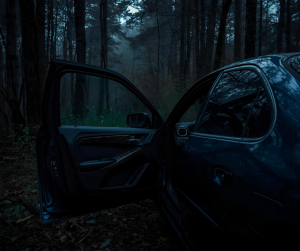
The plastic rain protector I’d placed over my hat worked well at keeping it dry. Still, the rain hitting the covering felt and sounded like hundreds of tiny mallets hammering all at once, as if an all-xylophone symphony decided to perform a complex syncopated piece on the top of my head. At a time when I truly needed the ability to hear a single pin drop, well, it simply wasn’t happening. So, xylophoned, machine-gunned, and gum-dropped from all sides, I slogged onward.

It was a fight to walk headfirst into swirling, stinging winds that tugged and pulled and pushed against my raincoat, sending its tails fluttering and flapping, exposing my brown over tan deputy sheriff uniform. The heavy winter material was not waterproof. Not even close.

The ground surrounding the car was a thick, gooey slop. With each step, my once-shiny brown shoes collected gobs of dense, soggy soil until the weight of my feet felt like a couple of bowling balls.

After making my way around the door, what I saw was shocking, even for a seasoned cop. The body of a young woman lay half-in and half-out of the car, with the outside portion being soaked by the deluge of water falling from the dark sky. Strands of her long hair reached the ground, where they dipped into a puddle, undulating with the back-and-forth motion of the wind-driven water.

Raindrops battered her open eyes, filling the corners until tiny rivers poured down her cheeks, spilling into the muck below.

I couldn’t tell for sure if she was alive or not, but instinct, experience, and the obvious clearly said, “Not.”

These, during a dark and stormy night, were the abysmal conditions in which I met the crying dead woman.

It was one-on-one—me and the victim.

I know, this sounds like a bit of overwriting when describing the setting; however, I wanted you to experience it as I did, and believe me, the feeling that night was, well, over the top. You should know and see in your minds that raindrops the size of gumdrops pelted the victim’s face, gathering and pooling at the corners of her eyes, eventually spilling out across her cheeks like tiny rivers that followed the contours of her flesh until they poured from her in miniature waterfalls.

You should know this because …

She Was a Dead Woman Crying in the Rain

Driver’s door,

Open.

Bottom half in,

Top half out.


Lifeless hand,

Resting in mud,

Palm up.

Face aimed at the sky.


Rain falling,

Mouth open.

Dollar-store shoes,

Half-socks.


Youngest daughter—the seven-year-old,

Called them baby socks.

Her mother’s favorite,

Hers too.


Hair,

Mingled with muck,

And water,

Sticks and leaves.


Power lines,

Overhead.

Crackling,

Buzzing.


Flashlight,

Bright.

Showcasing

Dull, gray eyes.


Alone,

And dead.

A life,

Gone.


Three rounds.

One to the head,

Two to the torso.

Kill shots, all.


Five empty casings,

In the mud.

Pistol.

Not a revolver.


Wine bottle.

Beer cans.

Empty.

Scotch.


“No, we don’t drink. Neither did she. Except on special occasions. Yep, it must have been something or somebody really special for her to drink that stuff.”

“Was there a somebody special?”

Eyes cast downward.

Blushes all around.


“Well … she did stay after Wednesday night preaching a few times. But they were meetings strictly about church business. After all, he is the Pastor. A good man.”

More blushing.

A stammer, or two.

A good man.


The rain comes harder,

Pouring across her cheeks.

Meandering

Through her dark curls.


Droplets hammer hard

Against her open eyes.

Pouring into tiny rivers,

Filling the puddles below.


She doesn’t blink.

Can’t.

She’s a dead woman crying,

In the rain.


Tire tracks.

A second car.

Footprints.

Two sets.


One walking.

Casually?

A sly, stealthy approach?

The other, long strides.


Running, possibly.

Zigzagging toward the woods.

Bullet lodged in a spruce pine.

One round left to find.


Cold water inside my collar, down my back.

Shivering.

Cloth snagged on jagged tree branch.

Plaid shirt.


Blood?

Still visible,

in the rain?

The missing fifth round?


Maglite never fails, even in torrential rain.

Cop’s best friend.

A shoe in the underbrush.

Attached to a man.


Dead.

Bullet in the back.

The fifth round.

Coming together, nicely.


Church meetings.

Pastor.

Two lovers.

A special wine for a special occasion …


A good man.

Sure he is.

Police car,

Parks at curb.


Morning sunshine.

Tiny face,

Peering from window.

Waiting for Mama.

Scent of frying bacon in the air.

Door swings open.

Worried husband.

“No, she didn’t come home after church. Called friends and family. Nobody knows.”


Husband, devastated.

Children crying.

“Yes, I have news. 

And I’m so sorry for your loss.”


Tire tracks match.

Pistol found.

Pastor,

Hangs his head in shame.


Special occasion.

To profess love.

But …

Another man.


A second lover.

Anger.

Jealousy.

Revenge.


Handcuffs.

Click, click.

Murder’s the charge.

No bond.


Single, unique plant seed,

Stuck to the brake pedal.

The single bit of evidence,

That tied him to the scene.


Got him.

Prison.

Life.

No parole.


A “good man”, a preacher, left the little girl’s mama to cry in the rain, wearing baby socks.


Today, decades later, raindrops squiggle and worm their way down the panes of my office windows.

And, as it often happens on rainy days,

I think of the crying dead woman.

Of her kids,

Her loving husband,

And,

Of course,

Baby socks.

Writers, Name Your Poison

It was a new novel, the third in her latest series, and, as always, in the early stages of the process the seasoned author required a new notepad for jotting down ideas, thoughts, and research notes. So she flipped back the blue cardboard cover to reveal the first page of the freshly-purchased spiral notebook.

A different color notepad for each book. The last one, red, for Nothing Could Be Finer Than a Murder in Carolina, and the one before it was green for her bestseller Strawberry Fiends Forever. This one, the blue one … Blood on the Beach.

Six new #2 pencils lay on her desk. Beside them was a pencil sharpener made to look like an elephant. To sharpen a pencil one simply inserted it into the elephant’s rear end, then crank the trunk to set in motion the internal bits and bobs that ground away the parts of the pencil that prevented its end from being pointy.

She stared at the blank page for a moment while various settings and scenes came to life on her internal movie screen. Characters, some old and some new, began to breathe, smile, and walk and talk. They moved slowly at first, as if they’d just received their first sets of arms and legs. They were as unsure of their footing as they were of why they were where they were and how they’d gotten there.

It wasn’t long, though, before heroes and villains and secondary make-belive folks picked up speed until they were doing clever, cunning, charactery things that could potentially send them toward their final desination, a page called “The End.”

The crafty writer, a devout plotter, sketched out a rough timeline, working in reverse from the discovery of the body. Everything looked wonderful and she was well on her way and she was excited because this one felt so, so right. Yes, this one just might finally earn her an Edgar Award. First, though, she needed an ingenious cause of death.

Shootings were overdone, done to death, actually. Bludgeonings are boring. Stabbings are always far too up close and personal. And they’re messy. Cut brake lines are predictable and cliche’.

But a good poisoning, if done correctly, can lead a reader down a tight and sometimes terrifing, twisty plot that’ll keep them turning pages well into the night.

Toxins, the good ones, are reliable, and they’re hard to detect at autopsy, if the killer is careful about hiding evidence. Yes, this one would be a good, old-fashioned poisoning.

It was time to begin her favorite part of writing … research.


Poison as the Weapon of Choice in a Fictional Murder

Writers of various genres often spend countless hours devising clever and hopefully undetectable ways of sending murder victims to their graves. One such favored instrument of death, poisoning, has proven quite reliable on the written page.

To help with your research, below are a few deadly toxins that thrive naturally. So they’re “easy pickins’ for the villains in your stories.

Remember, though, that these fatal floras are available and ready for picking not just by fictional characters, but by anyone, even your spouses, partners, coworkers, and friends and/or enemies. Some of these plants could even be found in backyards or beside favorite hiking trails.

So, if you’ve had a few rocky days of at-the-top-of-the-lungs, dish-throwing arguing after doing and saying some of the dumbest, most insensitive things you could possibly say and do, perhaps you should be on high-alert if the better-half suddenly decided to spend an afternoon in the woods foraging for healthy wild greens and mushrooms. Sure, she said she wantd to keep you young and in good physical condition by preparing better heart-healthy meal choices, but revenge for things said and done that you can never take back could come in the form of a side dish that includes a portion of chopped belladonna, or hemlock.


The Poisons

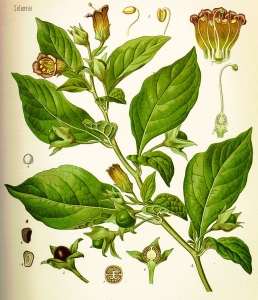
Belladonna, often called nightshade, is a popular ornamental plant. It’s name means “beautiful woman” in Italian. A single six or seven drop dose derived from the plant’s toxic parts (roots, leaves, and berries) can cause death within a few hours. Victims could also suffer miserably for a few days before succumbing to the plant.

Symptoms include increased heart rate, rapid pulse and respiration, fever, convulsions, and coma. Some have said belladonna poisoning even causes a loud heartbeat that can be heard from several feet away.


Belladonna is also known as Belle-Dame, Belle-Galante, Bouton Noir, Deadly Nightshade, Devil’s Cherries, Devil’s Herb, Dwale, Dwayberry, Grande Morelle, Guigne de la Côte, Herbe à la Mort, Herbe du Diable, Naughty Man’s Cherries, and Poison Black Cherries, and more.

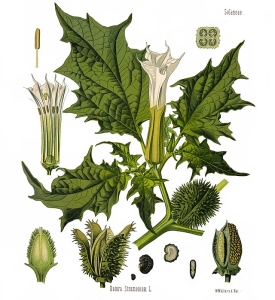
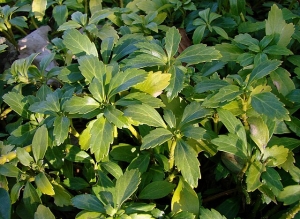
Jimson weed

In 1676, in Jamestown, Va., a potion was concocted to help relieve the distress of soldiers involved in the Bacon Rebellion. One of the potion’s ingredients was a readily available wild plant typically used by the settlers to make salves for treating burns.

Soon after ingesting the newly formulated distress-relieving remedy, the soldiers developed unexpected hallucinations and other peculiar behavior. The wicked weed, originally known as Jamestown weed, is now known as Jimsonweed (Datura stramonium).

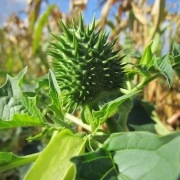
Jimsonweed is a potentially deadly plant that’s sometimes abused as a hallucinogen. All parts of the plant are poisonous, but the leaves and seeds contain the high concentrations of atropine, hyoscyamine, and scopolamine.


Street Names for Jimson Weed: Thornapple, stinkweed, locoweed, augushka, ditch weed, devil’s snare, devil’s seed, devil’s trumpet, Korean morning glory, Jamestown weed, angel’s trumpet, beelzebub’s twinkie, madhatter, and crazy tea ~ DEA

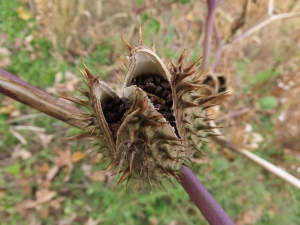
A single jimson weed seed pod can contain as many as 100 individual seeds. One hundred jimson weed seeds contain approximately 6 mg of atropine. A dose of atropine exceeding 10 mg is regarded as potentially lethal.

Ingestion of jimson weed produces the toxidrome—a group of symptoms associated with exposure to a particular poison—of anticholinergic intoxication. The classic signs and symptoms of anticholinergic intoxication include “dry, flushed skin; hallucinations; agitation; hyperthermia; urinary retention; delayed intestinal motility; tachycardia; and episodes of seizure. The mnemonic for anticholinergic symptoms—“’blind as a bat, dry as a bone, red as a beet, mad as a hatter, and hot as a hare.'” ~ National Library of Medicine.

Prison inmates working on roadside cleanup crews often harvest the plant’s tiny black seeds that, when consumed, produce the unusual high that’s associated with this prickly plant.

Jimsonweed seed pod containing dozens of tiny, black seeds

Jimsonweed seed pods contain as many as 100 tiny, black seeds

For example …

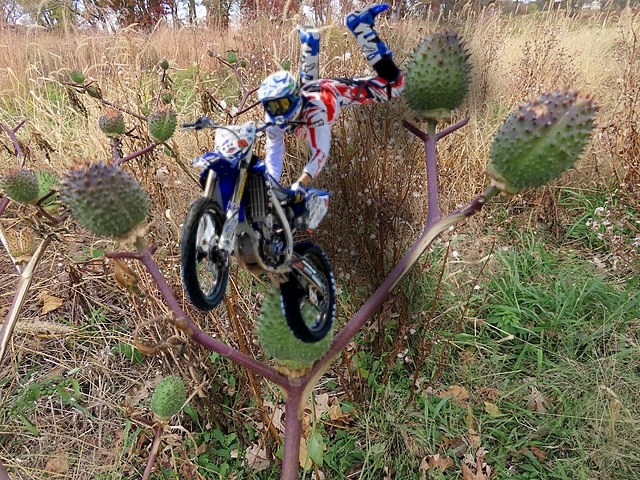
Once, while working as a corrections officer inside a maximum security facility, I overheard a young inmate called Short Timmy who was severely straining his vocal chords while loudly imitating the sounds of a motorcycle engine. And, amid the vrooms, zooms, growls, roars, and revving and snarling motor noises, were brief chuckles, giggles, and an enthusiastic argument Short Timmy was having with an imaginary biker he called Buck.

Buck was, as I later understood, fully-clothed in biker attire, including  a helmet. Buck’s imaginary appearance was in sharp contrast to the the very real and absolutely naked Short Timmy. Buck, as explained to me, was quite the acrobat and trick-rider.

Obviously, one of the major side effects of Jimsonweed consumption is delirium, and Short Timmy’s hallucinations were working overtime as I rounded the corner of the open-stalled bathroom area where he sat on a toilet wearing nothing but curly, shoulder-length greasy hair and neck-to-toe jailhouse tattoos, front, back, sides, and ALL appendages. Other than that, he was totally nude. He’d also slathered his entire body with a genrous portion of some sort of oil. He smelled like a salad dressing or the beginnings of fried chicken or French fries, so I assumed he’d gotten his hands on cooking oil from the dining hall kitchen.

Short Timmy sat there in all his natural glory, with his bare, heavily pimpled, inked bottom perched atop a big old flush-capable stainless steel “Harley.”

He held his hands as if they were gripping handlebars, throttle, and brake controls, and he was pushing his fictitious bike to its limits. He leaned his body leaned forward over “the handlebars” to reduce wind friction, I supposed, and he did so while laughing like a madman, in short bursts of chimp-like squeals and screeches.

When he saw me his lips split into a tight grin as he wiggled his stubby and grubby fingers in my direction. The gesture was a childlike bye-bye wave aimed at me just before throttling the metal toilet into high gear. He shouted a few words to Buck (above the engine sounds) and he leaned further toward the front tire, crouching low while turning the throttle as far as mechanically possible. I assumed that he and Buck were riding off toward the horizon to avoid capture. They were doing 180 mph, or more. A guess, of course, because I didn’t have a radar unit handy. Not much need for one inside a prison bathroom, you know.

Their high rate of speed didn’t work, though, because the powerful bike was no match for my shiny and black fake leather shoes. Yes, miraculously, I was able to effectively pursue and catch up to the pair—Short Timmy and Imaginary Buck—on foot.

I easily apprehended the desperados and carted both to the medical department. Buck was released and soon disappeared into wherever it is specters live until they’re again needed. Short Timmy, after a brief stay in the infirmary because of his consumption of homemade jimson weed tea, spent a few weeks in “the hole.”

In addition to delirium, other jimsonweed side effects are blurred vision vertigo, blindness, involuntary movements, convulsions, coma, and sometimes death.

*The largest single outbreak of jimson weed poisoning—293 suspected cases—occurred in 2019, in Uganda, where villagers consumed contaminated corn-soy relief food sourced from Turkey, by way of Mombasa, Kenya. Five deaths were reported.

Unintentional Jimson Weed Poisoning in a Family

One evening, a woman prepared a home-cooked soup using ingredients she’d gathered from her own backyard garden. When done, she, her husband, and their daughter sat down to enjoy the meal.

Not long after, a medical response team received a call from the family’s neighbor, who was concerned about the sudden downturn in their physical condition.

The family was rushed to the ER, where they were treated for intense nausea and vomiting, visual disturbances and hallucinations, skin flushing, and peculiar behavior. To add to the concern, the woman was 18 weeks pregnant. During her examination, she was observed reaching out to grab and clutch objects that weren’t there, and she conversed with people who were also not present.

Since the husband consumed a larger portion of the soup, the effects of the poison were far more pronounced in him than in his wife and daughter, and he was treated accordingly, including a stay in ICU. His hospital stay was for seven days, theirs was for less.


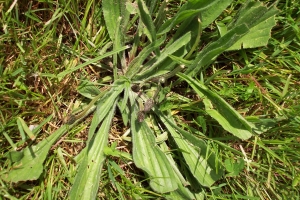
*Jimsonweed has a shallow root system and is easily eradicated by hand-weeding, especially as a young plant. Contact with plant parts is of no danger. Broadleaf herbicides such as 2,4-D, a broadleaf weed killer is used to control weeds such as pesky plantain, and to prevent the growth and unwanted spreading of ground cover such as pachysandra, and it provides control of jimson weed.

Plantain - weed

Plantain – weed

Pachysandra terminalis


Lilly of the Valley, aka Our Lady’s Tears, is found throughout the United States and Canada. The plants toxicity level is quite high, a level six, and causes an immediate reaction to the unsuspecting victim. Even the water in which the plant’s cut flowers are kept is deadly. Symptoms include, hallucinations, vomiting, clammy skin, hot flashes, coma, and death.



Spotted water hemlock

Hemlock

Finally, for the last poison du jour, we must first journey back in time to 399 BC, when philosopher Socrates was on trial for corrupting the minds of the youth of Athens. In addition, he was charged for for worshipping false gods instead of worshipping the officially recognized gods of Athens.

Not having the benefit of hearing the future what is now referred to as “the old adage that he who represents himself has a fool for a client,” Socrates chose to represent himself during the proceedings. And, as would be expected even in modern times, a jury found him guilty.

Socrates, knowing the penalty for his crimes could be quite serious, jokingly suggested that his punishment be that the state provide him with free food and housing for services he rendered to the city. Of a more serious note, he asked that he be fined his entire net worth, one mina of silver (approximately 1.25 pounds). The jury rejected the philosopher’s offer and sentenced Socrates to death. He was made to drink a cup of deadly hemlock, possibly wine infused with the deadly poison.


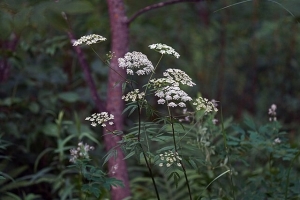
Spotted water hemlock can be found growing most of North America. It’s a highly poisonous plant grows along ditches and wet areas throughout most of North America, including on our property.


In the Midnight Hour: A Cup of Joe, Maggots, Memories, and Run-On Sentences

Working the first 240 minutes of the graveyard shift, when the crazies and criminals come out to play, and when many normal and sane folks allow alcohol and drugs to take over the part of the mind that controls mean and nasty, is a timeframe that generates many a tale told by crusty old retired cops who sometimes gather at pancake houses to share breakfasts with their remaining former brothers and sisters in blue. The ones still alive and who care enough to talk about the good old days, that is.

Like weekend fishermen sometimes share tales about the big ones that got away, these antecedent cops gather at favorite greasy spoon breakfast diners to tell, retell, and compare “just-like-it-was-yesterday” stories using excitement-induced run-on sentences to detail events of the heart-pounding times when bullets zinged and pinged off the pavement around them as they rushed to capture wanted criminals who’d popped off those rounds before disappearing into abandoned warehouses or alleyways during nights as black as ink with air so still they could hear their own blood zipping its way through the convoluted paths of veins and arteries as nervous hearts worked in overdrive mode to keep up with the amount of adrenaline racing through their bodies as they searched for the hidden bad guys who’d as just soon kill a cop as they would eat a ham sandwich.

Yeah, those kinds of jittery and sometimes PTSD-infused run-on comments about remarkable accomplishments and incredible feats of top-coppery are the sort of stories that take center stage while the sounds of sizzling bacon and spattering sausage patties provide the soundtrack to the morning gatherings.

As the scent of warm toast wafts through the air, the men and women who’d instantly shed twenty-five pounds when they handed over their bulky gun belts on the day they’d received their “Retired” badges, fawningly speak of the days before semi-automatics and Kevlar vests and of car radios that weren’t capable of sending or receiving signals out in the distant areas of the county, leaving the solo officers on their own to handle whatever came their way.

The old-timers compare scars—the raised marks on the hands, arms, and faces they’d earned when arresting the tough guys who loved to use razor-sharp blades to slash at cops. Occasionally, one of the balding and wrinkled retired patrol cops shows off a zig-zagged raised area on the cheek, a disfigurement due to being on the receiving end of a downward-plunge of an ice pick or screwdriver.

It was early morning, 2 a.m., according to the portly ex-officer whose once rock-steady hands trembled unmercifully these days, when he and the other members of the entry team stood on the non-moonlit side of a house deep in the heart of the worst area in town. While waiting for the signal to kick the door,  he listened to the distant soulful moan of train whistle and the clicking and ticking of windblown dried and crunchy fall leaves as they tumbled and danced their way across cracked pavement. It was cool out, but beads of fear-sweat the size of baby garden peas wormed their way down his spine, slipping through that void between the waistband and the hot flesh at the small of the back. He felt his badge pulse out and in ever so slightly with each thump of his nervous, worked-up heart.

Others recalled the animals that shared the night shifts with them—the skinny three-legged dogs and wiry cats with matted fur, washboard ribs, and gangly crooked tails and jagged fight-damaged ears. Raccoons with eyes that burn yellow or red when met with the bright beam of the car-mounted spotlight. Possums that hiss and bare pointy teeth when cornered.

There was the old wino, the guy who wore nine layers of clothing, a filthy watchman’s cap and toeless boots, a homeless man who reeked of body odor so horrific that jailers hosed him down before fingerprinting him. He’s the guy who often had maggots wriggling around inside his ratty underwear, and whose BVD’s were rarely removed before using the bathroom. A waste of time, he’d said. Why bother? Yes, they’d all seen and smelled the funk when they’d arrested him and others like him for breaking into cars, shoplifting bottles of booze, or stealing cheap aftershave to drink because it contained alcohol.

A turn onto main street after checking the alley between the hardware store and the Five and Dime revealed storm drains at the curbs spewing wispy tendrils of sewer steam that combined with hot city sweat before melting into a dark sky spattered with thousands of pinpoint lights.

Stoplights as far as the eye could see, all winking and blinking in an ill-timed discord of reds and yellows and greens.

The street sweeper who passed by, holding up a single finger as a sleepy acknowledgment that he, too, was out there in the night making ends meet the best way he knew how.

Drug dealers and prostitutes faded into darkened storefronts as patrol cars slowly rolled past.

Yes, one last refill, please. No cream. No sugar. Just like the thick jailhouse coffee that kept their motors running back in the day. Then it’d be time to take the spouse’s car in for an oil change, or to stop by the market for bread and milk and eggs. One had a doctor’s appointment. The ticker’d been acting up a bit lately.

Back to the stories, though. There’s always time for one or two more before the full breakfast crowd began to drift in, the folks wanting over-easy eggs, cheese omlets, piles of crispy bacon and pieces of country ham, stacks of steaming pancakes and waffles topped with fresh berries and whipped cream and elderberry or maple syrup.

A pair of young troopers enter, remove their campaign hats, and take a seat at the counter. The server slides cermaic mug of coffee in front of each. Their radios crackle and a dispatchers’ voice cut through the air in a monotone voice that could’ve just as easily come from robot in a sci-fi film.

They all remember and nod. And they stop to think. Each of them.

It was just last night when they’d each slipped on the uniform and badge and gun and shiny shoes. A pen in the shirt pocket and a slapjack in the right rear pants pocket.

Sirens and red lights.

Wife beaters. Robbers, Rapists.

Murderers.

Their war-wounds.

The missing bit of earlobe. The punk was, of course, a biter.

The loss of vision in the left eye. A 2×4 to the head, a blow delivered by a beefy, tatted-up redneck who didn’t want to see his brother carted off to jail.

The lifetime limp. A drunk driver who swerved right while the officer helped an elderly man change a tire.

The disfigured hand and scar tissue. Rescuing a little girl from the burning car.

Closing their eyes and seeing the face of the dead guy floating in the river, the one whose eyes became a tasty snack for turtles and fish.

The decapitated head at the side of the railroad tracks. Headphones prevented him from hearing the train approaching from the rear. They were found dangling from a thin tree branch along with a clump of hair still attached to a small bit of flesh and shattered skull.

The teen with the knife-punctured carotid artery that spurted long arcing jets of bright red blood onto the hands and arms and faces and clothes of responding officers as they tried to save the fatally wounded youth.

The punches, the bruises, the kicks.

The foot chase between the houses.

The struggles.

The guns.

The shots.

The coroner.

The nights.

The long, lonely nights.

The nightmares.

And then morning comes and it’s time to do it all again.

It’s all they have left.

Memories.

That, and those broken lives and bodies.

And a cup of joe.

Black, no sugar.

Just like the good old days.


Thompson Sub-Machine Gun


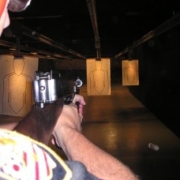
This is what it looks like to peer down-range from behind a Thompson fully-automatic submachine gun. You can actually see a spent cartridge ejecting at the lower right-hand side of the picture, just above the major’s right elbow.

The Thompson is an extremely heavy weapon that’s capable of firing 900 rounds of .45 caliber ammunition per minute, and let me tell you, that’s fast. The experience of firing one of these babies is like no other. I took this photo and was peppered with gunpowder during each burst of gunfire, even from the distance where I stood, which was as you see it. I didn’t use the zoom. We took this shot in a controlled situation while wearing full protective gear and employing other safety precautions. I say this because I don’t recommend this method of photography. It’s not safe. Gee, the things we do for book research.

The Thompson was extremely popular in the 1920s among both law enforcement and gangsters alike. The notorious John Dillinger and his gang amassed an arsenal of these “Chicago Typewriters.” The FBI and other agencies, such as the NYPD, also put Tommy Guns to use in their efforts to battle crime. In fact, the weapon became so popular in law enforcement circles it earned another nickname, The Anti-Bandit Gun.